Echoes of the Tomcat
How a mix of legacy American interceptors and Soviet surplus created the world's most uniquely isolated air force.
The sky over the Zagros Mountains carries a distinctive, tearing roar that hasn't been heard in the West for nearly two decades. It is the sound of twin General Electric TF30 engines, pushing a swept-wing relic through the thin air. Against all geopolitical odds, the Grumman F-14 Tomcat is still flying.
Prior to the 1979 revolution, the Imperial Iranian Air Force was the jewel of the Middle East. Bolstered by massive oil revenues and a blank check from Washington, the Shah of Iran purchased state-of-the-art American hardware. The crown jewels were 79 F-14 Tomcats, equipped with the top-secret AWG-9 radar system and the deadly AIM-54 Phoenix missile.
The Embargo and the Ingenuity
When the regime fell, the newly formed Islamic Republic of Iran Air Force (IRIAF) inherited a massive fleet of Western aircraft, but instantly lost the supply chain required to maintain them. The United States imposed strict embargoes, fully expecting the highly complex Tomcats, Phantoms, and Tigers to become grounded museum pieces within months.
"They were cut off from blueprints, from parts, from manufacturer support. Every time a jet took off, it was a testament to extreme mechanical improvisation."
Instead, the outbreak of the devastating Iran-Iraq War in 1980 forced extreme ingenuity. Iranian engineers began a massive campaign of cannibalization and reverse-engineering. They hand-machined microscopic radar components. They adapted ground-to-air Hawk missiles to be fired from the wings of F-14s when their Phoenix stocks ran dry. The legacy American fleet, against all odds, held the line against waves of Iraqi Mirages and MiGs.
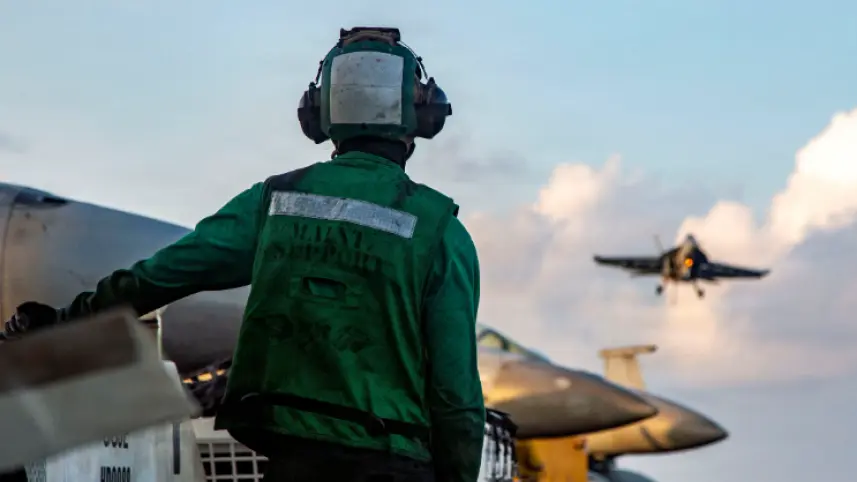
An IRIAF F-4 Phantom II, originally delivered in the 1970s, remains a primary ground-attack platform today.
The Eastern Infusion
As the war ground to a halt in the late 1980s, the battered Iranian fleet needed reinforcements. Cut off from the West, Tehran turned to Moscow and Beijing. They acquired fleets of highly maneuverable MiG-29 'Fulcrums' and Sukhoi Su-24 strike bombers.
The situation became even more complex during the 1991 Gulf War. Dozens of Iraqi pilots, fleeing the overwhelming coalition air campaign, flew their aircraft across the border into Iran. Tehran simply seized the jets as reparations for the previous decade's war, suddenly integrating French-built Mirage F1s and additional Soviet hardware into their ranks.
Today, a visit to an Iranian airbase is like stepping into an alternate history of the Cold War. American F-4 Phantoms share tarmac space with Russian MiG-29s. Chinese F-7s fly patrols alongside F-14 Tomcats. It is an air force built entirely on necessity, isolation, and a sheer refusal to be grounded.